
If you’re choosing IB subjects and feeling stuck on math, you’re not alone.
For most students, math is the one subject that makes the decision feel heavier than it should. It’s two years long. It affects university applications. And somewhere in the background, there’s always that quiet pressure — “What if I choose the wrong level?”
So let’s remove the drama from it.
This isn’t about picking the “harder” option to impress someone. It’s about understanding what each level really asks of you — and whether that fits the kind of student you are.
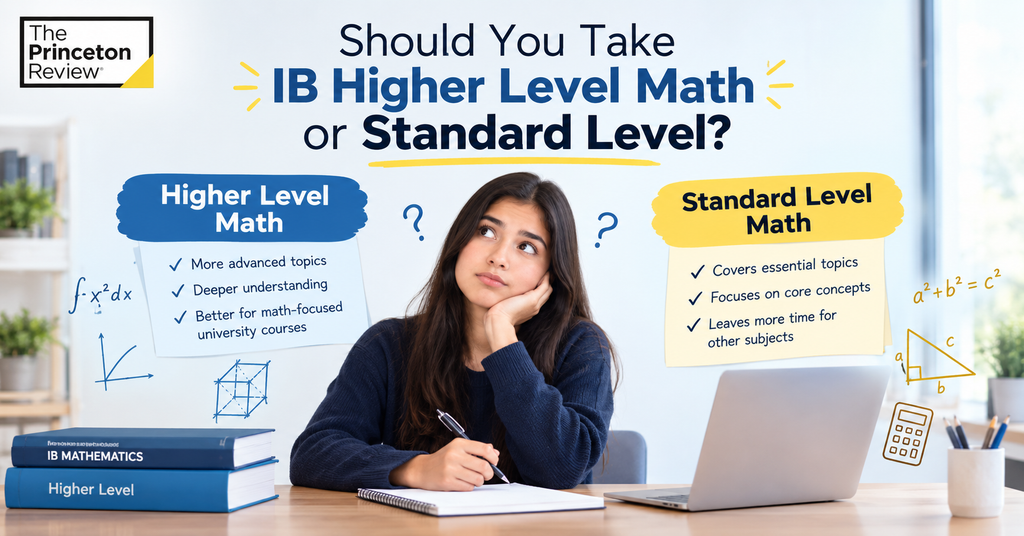
Higher Level (HL) and Standard Level (SL): What Actually Changes?
Both Higher Level (HL) and Standard Level (SL) require real effort. IB math, regardless of level, is not something you casually get through.
The difference shows up in three main ways: depth, pace, and mental stamina.
HL doesn’t just give you more questions. It pushes concepts further. You spend more time proving why something works instead of just applying a formula. Calculus goes deeper. Algebra becomes more layered. Questions often feel like puzzles with several moving parts.
SL still builds a solid understanding. You’ll work with serious mathematical ideas. But the problems are generally more direct, and the pace allows a bit more breathing room.
A student once described it perfectly:
“SL felt like learning how to use tools properly. HL felt like learning how to design the tools.”
That’s not a ranking — just a different experience.
Be Honest: Do You Actually Like Math?
This is the question students avoid.
Not “Are you good at it?”
Not “Did you score well last year?”
But — do you actually enjoy it?
HL works best for students who don’t mind sitting with confusion for a while. The kind who will try three approaches before giving up. The type who will occasionally redo a solution to see if there is a more elegant way of doing it.
If you are thinking of doing a degree in engineering, physics, mathematics, economics, or computer science at a highly competitive university, then HL is probably the safer option. In some cases, it’s expected.
But liking math matters more than being naturally fast at it. HL rewards patience. If you dislike long, layered problems, the course can start feeling exhausting very quickly.
When SL Is the Smarter Move
There’s a strange myth that choosing SL means you’re avoiding a challenge. That’s not true.
Sometimes SL is strategic.
If you’re planning to pursue law, psychology, design, business (depending on the country), media, or other non-math-intensive fields, SL is often completely acceptable. Many universities simply want to see that you handled IB math successfully.
And here’s something students rarely admit: IB as a whole is demanding. If you’re already taking two or three other heavy HL subjects, adding HL math might stretch you thin.
Strong overall performance often matters more than stacking the hardest possible combination.
Universities Care About Fit, Not Ego
Before you decide, look at the actual university entry requirements for the courses you might apply to. Not rumors. Not assumptions.
Some STEM programs clearly require HL math. Others recommend it. Many non-STEM programs don’t.
If you’re unsure about your future path, HL does keep more doors open. But only if you can perform well in it.
A 7 in SL is often stronger than a 4 in HL. Universities notice consistency and strength, not just difficulty level.
Let’s Talk About Workload (Without Sugarcoating It)
HL math requires steady effort. The process of catching up becomes extremely difficult after you fall behind for two weeks because subsequent topics require knowledge from previous material.
Internal assessments demand more depth. Exam questions are rarely straightforward. You’ll need regular practice — not last-minute revision.
SL still requires discipline, but it’s more forgiving. You’ll likely have more mental space for other subjects, extracurriculars, and university applications.
Ask yourself: what will your full IB schedule look like? Math doesn’t exist in isolation.
A Few Questions That Actually Help
Instead of asking whether you’re “smart enough,” try this:
- When math gets hard, do I shut down or get curious?
- How much time am I realistically willing to give this subject every week?
- Am I choosing HL because I want it — or because it sounds impressive?
- What subjects am I pairing it with?
Answering these honestly is more useful than comparing yourself to classmates.
Ask Someone Who’s Seen You Learn
Your current math teacher has watched how you handle difficulty. That perspective is valuable.
Ask them directly whether they think HL suits you. Not in a dramatic way — just practically. Teachers often see patterns that students miss in themselves.
Sometimes they’ll say, “You can handle it.”
Sometimes they’ll say, “You might be happier in SL.”
Both answers can be helpful.
How The Princeton Review Can Help You Prepare
No matter what level you choose, it is obvious that preparation matters.
The Princeton Review assists IB Math students in both HL and SL levels by enhancing their foundation, understanding complex concepts, and increasing confidence in taking exams. Their teachers not only instruct students on how to solve questions but also on how to identify patterns, structure, and strategy, which is very helpful in IB exams.
Students can be confident about the course rather than feeling lost after practicing and receiving feedback. Whether you are entering the world of HL or conquering SL confidently, you can definitely benefit from it.
The choice between HL and SL matters. But being prepared for the level you choose matters even more.
Take a breath. Think long-term. Then choose the path that feels challenging — but sustainable.
Final Thought: Choose Growth, Not Pressure
HL is challenging in a way that can feel deeply satisfying — if you’re wired for it.
SL offers stability and balance — which, in IB, is sometimes exactly what you need.
This decision doesn’t define your intelligence. It doesn’t define your ambition. It simply shapes your workload and academic focus for two years.
Pick the level where you can stay consistent, confident, and motivated — not constantly anxious.
That’s the real win.