
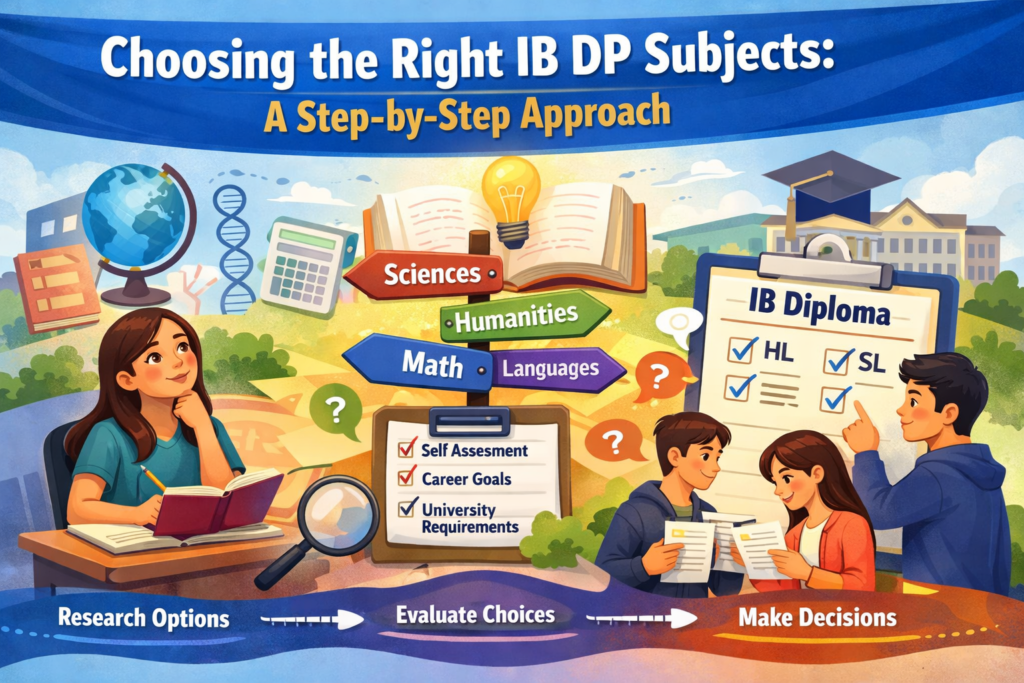
When students look back on IB, most of them don’t regret how much they studied. What they usually regret is choosing subjects without fully understanding what they were getting into. At the beginning, everything sounds manageable. Two months in, reality sets in. Some subjects start to feel familiar. Others feel like they’re constantly demanding attention.
That’s why subject choice matters so much. It is not that the IB decides your whole future, but it does shape what your days will be like for the next couple of years. Pick wisely, and the IB will feel hard but doable. Even basic tasks will be exhausting if you attempt to perform them with perfection as your sole objective; remember: it’s about perseverance.
Many students make the right choice when they can decide on their fields of study, by themselves, based on their own interests and abilities, instead of being told by another person to study that field.
Step 1: Know the Organization before Making a Decision
Understanding the IB Diploma Programme framework should come before making decisions about your interests and plans. You have to choose six subjects, one from each group:
- Language and Literature
- Language Acquisition
- Individuals and Societies
- Sciences
- Mathematics
- The Arts (or a replacement from Groups 2–4)
Among these six subject areas, three will be HL courses while three will be SL courses. HL subjects cover more material and usually move faster.
What many students miss is that IB pressure doesn’t come from one “hard” subject. It comes from how all six subjects overlap. Even average subjects can feel swamped if the tasks require the same energy and the same focus.
Step 2: Consider Your Actual Working Style, Instead of Your Desired One
It is tempting to select subjects according to what kind of studying we wish we could do. IB quickly exposes the difference between intention and habit.
Ask yourself:
- Which subjects do I keep up with even when I’m busy?
- What kind of homework do I finish without forcing myself?
- Do I cope better with reading, writing, calculations, or hands-on work?
Just liking a subject doesn’t equal easy. It just means you don’t run from it.
Something Princeton Review advisors see again and again: Students tend to do better in subjects they’re okay with, compared to subjects they hate but picked ’cause they seemed smart for the future.
Step 3: Okay, think about the future, but do not go overboard.
If you have decided on the area that you would like to pursue after high school, you have made selecting subjects easier.
- Most health and technical careers include a large number of subjects in Biology and Chemistry as part of the course requirements.
- Engineering relies on Mathematics and Physics
- Economics and business benefit from Mathematics and Economics
- Law and humanities value writing and critical thinking
But many students don’t have a fixed plan. That is common.
Then, in this instance, versatility is more important than expertise. A combination with:
- A decent level of mathematics
- At least one science
- One subject that builds an argument or analysis
…keeps options open without adding unnecessary stress.
Universities care more about consistent performance than about how ambitious your subject list looks.
Step 4: Treat Higher Levels Seriously
HL subjects aren’t something you “try out.” Once IB starts, they’re part of your weekly workload, whether you feel motivated or not.
Before choosing an HL, ask:
- Can I keep up with this during busy weeks?
- Do the exams and assignments correspond with my style of learning?
- Is this something I want to do or something I am pressured to do?
Some HLs rely heavily on memory. Others demand fast writing or abstract thinking. Difficulty depends on fit, not reputation.
A realistic combination often includes:
- One HL you enjoy
- One HL you’re confident in
- One HL that supports your plans
- All decisions regarding alternates/adjuncts should be made carefully. If you feel you are not getting the right answer with your decision, contact the IB advisors at Princeton Review to help you make a better decision at the point that suits your specific circumstances.
Step 5: Look at What the Subject Involves, Not Just the Name
Subject titles can be misleading. What sounds interesting on paper may feel very different in practice.
Before finalizing choices:
- Skim the syllabus topics
- Understand how the Internal Assessment works
- Check how much independent planning is required
For example:
- Psychology involves structured research and evaluation.
- Visual Arts requires long-term commitment and self-management.
- Language B focuses more on communication than literary analysis.
Subjects usually become difficult when they don’t match how a student thinks or studies. The Princeton Review provides subject-specific prep that shows you exactly what each course entails, so you’re not surprised later on.
Step 6: Think about the Entire Workload Together
Having a heavy load of work in IB is not dependent upon the weight of each subject; instead, having a heavy workload is a result of having all of the subjects peak at the same time.
Here are some things to ask yourself:
- How many subjects involve frequent essay writing?
- How many include labs, projects, or portfolios?
- Will deadlines overlap often?
Even strong students struggle when multiple subjects demand the same type of output at the same time. Balance matters more than difficulty labels.
Step 7: Take Advice, But Make the Decision Yours
Teachers and counselors bring experience. Parents bring concern. Friends bring opinions. All of it can help—but none of it replaces self-awareness.
Use advice to:
- Understand expectations
- Identify possible challenges
- Think about long-term effects
At the end, you are the one doing the work. If a subject choice feels wrong early on, that feeling usually has a reason.
At Princeton Review, our advisors don’t push you toward any specific subjects. We help you ask the right questions to make choices that suit you.
A Few Things Worth Clearing Up
Some ideas cause unnecessary pressure:
- Harder subjects don’t guarantee better results. Steady effort matters more.
- Math HL isn’t required for every future path. It should make sense for you.
- Arts subjects aren’t “easy options.” They demand time, planning, and discipline.
Good subject choices come from understanding yourself, not competing with others.
Final Thought
There’s no perfect IB subject combination. There’s only the one that fits you. When your choices match your strengths and interests, IB becomes challenging but manageable.
Take your time. Ask yourself honest questions. Picture yourself studying these subjects every week. It won’t be easy, but choosing what suits you makes it easier to handle and more rewarding.
Need help choosing? Princeton Review’s IB advisors can help you figure out what works for you.