
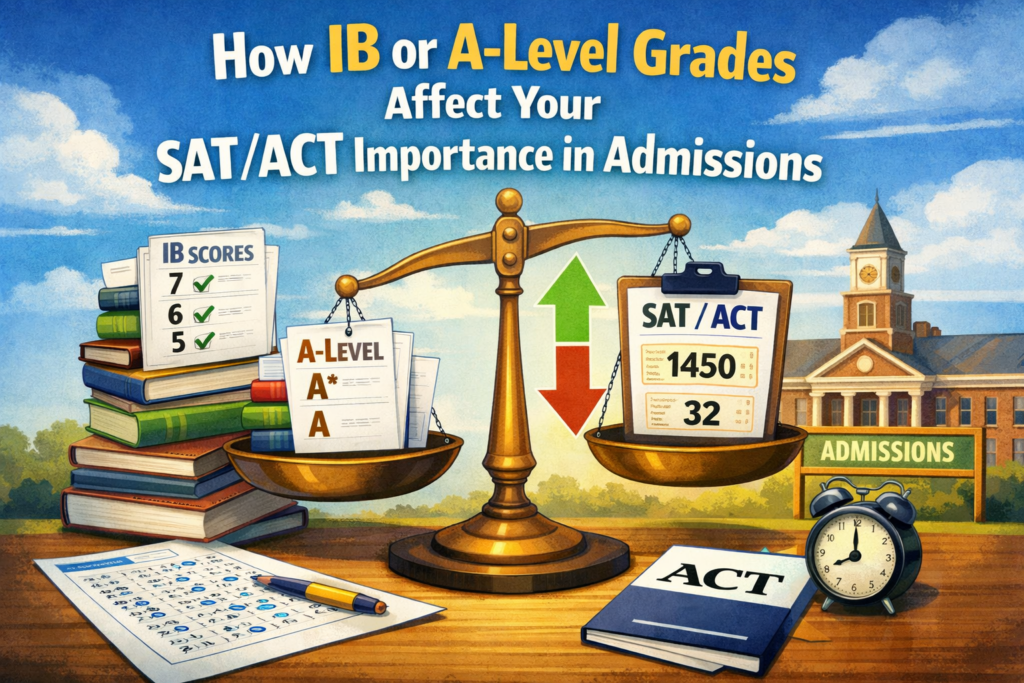
If you or a child is trying to make sense of the college selection process, you have no doubt been asked the following question several times: “How do SATs compare to A-Level qualifications or the International Baccalaureate, IB, qualification?” That question carries real weight. Admissions teams review a blend of academic credentials, and for international students—and even many U.S. students—understanding how standardized test scores like the SAT fit alongside diploma-based systems (IB or A-Levels) can make the difference between feeling lost and feeling confidently prepared.
The Truth About IB or A-Levels and Standardized Tests
Let me surprise you with this: your fantastic IB diploma or chain of predicted A*s does not erase your SAT and/or ACT scores from your application. Try it this way: admissions tutors are attempting to evaluate thousands of applicants from vastly different educational settings. While your IB grade reflects what you are capable of over a period of two years of dedicated learning, your SAT or ACT provides a glimpse, allowing for easy comparison between your application and that of the kid from the small American high school or the other candidate who follows a non-IB international curriculum.
They are not working against each other. Your grades at school—the requirements for your IB or A-Levels—and your grades on the test are two different stories. Universities want to hear both.
When Your IB or A-Level Performance Gives You Some Breathing Room
Let’s assume you are predicted an IB of 42 or perhaps an A*AA* at A level. This is an excellent start, and admissions understand this fact as well.
With test-optional institutions, you have plenty of options with such grades. Perhaps your SAT score is hovering around 1400 when the average is 1450; with such excellent grades predicted in school, you can opt to send those grades despite reservations about your test scores.
Some colleges, particularly those that know what some foreign curricula look like, realize that a kid who is absolutely blowing Higher Level Physics, Math, and Chemistry means that kid has some serious horsepower in academics. That means a lot, especially if they’re taking those classes because they relate to what they want to pursue at college.
For international students, in particular, having high grades in IB or A-Levels can be quite beneficial because you’re already performing well in a globally recognized college-level curriculum. You’re definitely not a mystery to anyone.
But Here’s Where It Gets Real
Even with a perfect score of 45 in IB, if you’re applying to schools such as MIT, Stanford, or Yale, they’re going to want to see good test scores as well. A score of 1200 or lower on the SAT will not get you very far, no matter how amazing your Extended Essay is. Such highly selective schools want students who perform well in every area.
And let’s talk about money for a second. Many scholarship programs have hard cutoffs for SAT or ACT scores. You could be the next Nobel Prize winner in the making, but if the scholarship requires a 1450 SAT and you have a 1380, you might miss out on thousands of dollars. Your IB diploma won’t override those automated systems.
If you’re eyeing competitive STEM programs, give special attention to your math section scores. Yes, maybe you aced HL Math, but even then, engineering or computer science admissions offices want to see those good standardized test math scores, too.
So What Should You Actually Do?
One, don’t think that something offsets the other if it’s weak. The students who get admitted to the best schools usually have strong performance in the curriculum as well as strong test results. You have to have both to really distinguish yourself.
Second, do some homework on each of the schools you are applying to. For instance, certain liberal arts schools may emphasize a well-rounded IB diploma more highly than a big state school may emphasize a strong set of test scores. Take a look at some common data sets and try to get a sense of what they are looking at.
Lastly, think about test-optional strategies. If your scores are equal to or greater than a school’s median, it may be worth submitting. If they are considerably lower, though otherwise your application is very strong, it might be worth not submitting. Just do not hold back your application if your test scores are not great.
Where The Princeton Review Comes In
Handling IB or A-Level coursework and preparing for SAT or ACT at the same time can be likened to juggling while riding a unicycle. That’s when and where The Princeton Review comes into play and makes life much simpler for you.
The Princeton Review recognizes that you are more than just a test-taker—one who is navigating a tough international education program while simultaneously figuring out the mystery that is the American standardized test circuit. The Princeton Review test prep courses are specifically engineered to net you the highest possible score, with minimal extracurricular time commitment—because you don’t have time for that anyway.
Why The Princeton Review Works for IB and A-Level Students
Here’s what sets The Princeton Review apart for students in rigorous academic programs:
Flexible Scheduling That Respects Your Workload: IB and A-Level students don’t have extra evenings to blow. With The Princeton Review, you have on-demand video lessons, weekend intensives, and customizable study schedules that work around your TOK presentations, Internal Assessments, and A-Level practicals. You study when it works for you, not when a rigid course schedule says you must.
Strategic Score Improvements That Matter: Unlike other services, The Princeton Review does not focus only on content but teaches how to use the knowledge a student has effectively to succeed. In regard to the SAT and ACT assessment tests, much value is placed upon the strategies used to answer high-yield questions and to properly prepare for the test. Those presently involved in a challenging academic workload appreciate the direct and efficient utilization of their time. For instance, the 100-point difference can make the difference between receiving a scholarship and paying total tuition; 8 million students realize similar results when taking advantage of the research-proven methods utilized by The Princeton Review.
Specialized Support for International Students: Most prep companies offer the same service to their students. The Princeton Review, however, understands that you, as an international student, have different circumstances, such as being exposed to different test forms, having a reading passage relevant to your culture, and the fact that you have to prove your English language skills and acumen. Our tutors, therefore, have been trained specifically to help you decipher American standardized tests while recognizing your hard-earned academic acumen.
Practice Tests That Mirror the Real Thing: The Princeton Review has been a test prep leader for more than 40 years, with practice materials that are unparalleled for accuracy. For students juggling IB exams and standardized tests, this means you don’t waste a single minute practicing with materials that aren’t like the real thing.
Proven Track Record of Results: The Princeton Review has been helping millions of students secure admissions in their desired universities with ease. The improvement of our students’ average scores needs no testimony, as we are constantly updating their strategies according to recent changes in tests and trends in admissions. If you are targeting top universities, it requires preparation that includes experience and success stories from several decades.
Final Thoughts
The short version: The data from SATs, A Levels, and IB programs provide different information to admissions committees. The SAT provides a standardized comparison, while A Levels reveal a deep level of understanding, and the results of IB programs reveal a broad education and autonomous learning. Alone, not one of these methods ensures acceptance, though collectively, a complete picture is revealed.
Effective applicants take a smart approach to applying, recognizing which aspects of their application to feature, preparing accordingly, and creating a story to connect those dots. When applying feels like a daunting task, professional preparation is the game-changer. The Princeton Review is equipped with effective test preparation strategies, private tutoring, as well as overall admissions counseling, to help students “zero in on strengths, shore up weaknesses, and present themselves at their best to colleges, thereby increasing their chances of gaining admission.”
Remember, admissions isn’t a competition of numbers; it’s a thoughtful, subjective decision. Aim for great qualifications, but in doing so, please, please, please don’t forget to tell your story. Your unique mix of tests, coursework, and life experience is your greatest strength. Wear that strength well.
Closing Encouragement
Student or not, if you’re reading this, you should know that the admissions teams are looking to read about honest and committed learners-your curiosity and the way you show up matter as much as any test. Your unwavering support as a parent and access to quality information are tremendous assets. Break everything down into manageable segments, recognize and appreciate each victory, and remember, using whatever combination: SAT, A-Level, IB, accomplished together, you have created an application depicting accurately who you are and who you want to be.
All the best! Also, if you are looking for specialized assistance at any point throughout this process, please do not hesitate to contact The Princeton Review.