
If you’re an IB student scrolling through university requirements and wondering, “How on earth do they compare my scores to SAT/ACT results?”—you’re not alone. This question comes up every admissions season, especially for students applying to universities in the US or other systems where standardized tests dominate the conversation.
The short answer? Universities don’t use a simple conversion chart taped to the admissions wall. The longer—and more useful—answer is much more nuanced, and understanding it can actually work in your favor.
Let’s unpack how universities really look at IB scores compared to SAT and ACT results.
Why IB Scores and SAT/ACT Scores Aren’t Directly Comparable
At first glance, it’s tempting to think admissions offices just “translate” one score into another. After all, both are used to measure academic readiness, right?
Not quite.
The IB and the SAT/ACT are designed for different purposes:
- IB is an academically challenging two-year course of study characterized by depth and rigor in critical thinking and performance.
- The SAT and ACT are timed tests that measure aptitude and academic ability.
This means that universities do not consider them equivalent. They evaluate each one in its own setting.
Take a comparison between a marathon runner and a sprinter. Both are runners, yet you wouldn’t use the same timer to measure performances.
How Admissions Officers Actually Evaluate IB Scores
1. IB as a Curriculum, Not Just a Number
One of the biggest advantages of the IB diploma is that universities view it as more than a score report. Admissions officers look at:
- Subject choices (Higher Level vs. Standard Level)
- Course rigor relative to what your school offers
- Predicted scores and final results
- Internal assessments and extended coursework
A student predicted a 38 with strong Higher Level subjects often signals academic readiness equal to—or stronger than—a high SAT score, even if no test score is submitted.
2. Context Matters More Than Precision
Universities are less interested in “What SAT score equals a 36 IB?” and more focused on:
- How challenging was your program
- How consistently you performed over time
- Are your outcomes comparable to those of other students in your school and region?
In effect, the scores are considered, in context, to reflect the student’s commitment to the discipline, as opposed to their performance on the actual exam.
Where SAT and ACT Still Matter
1. Benchmarking Across Systems
These types of standard exams can be easily compared between nations and institutions. That explains why some institutions still make use of them, especially when:
- Applicants come from unfamiliar grading systems
- Transcripts lack detailed course information.
- Schools don’t offer IB predicted grades.
In these cases, SAT/ACT scores act as a common reference point, not a superior one.
2. Test-Optional Doesn’t Mean Test-Ignored
Even in test-optional colleges, high scores in the SAT or ACT may still work in your favor, especially if your IB scores are not quite what is expected or if your records are not complete.
However, many universities overtly declare that the complete IB diploma can replace standardized test scores entirely.
Informal Score Comparisons (What Universities Rarely Say Out Loud)
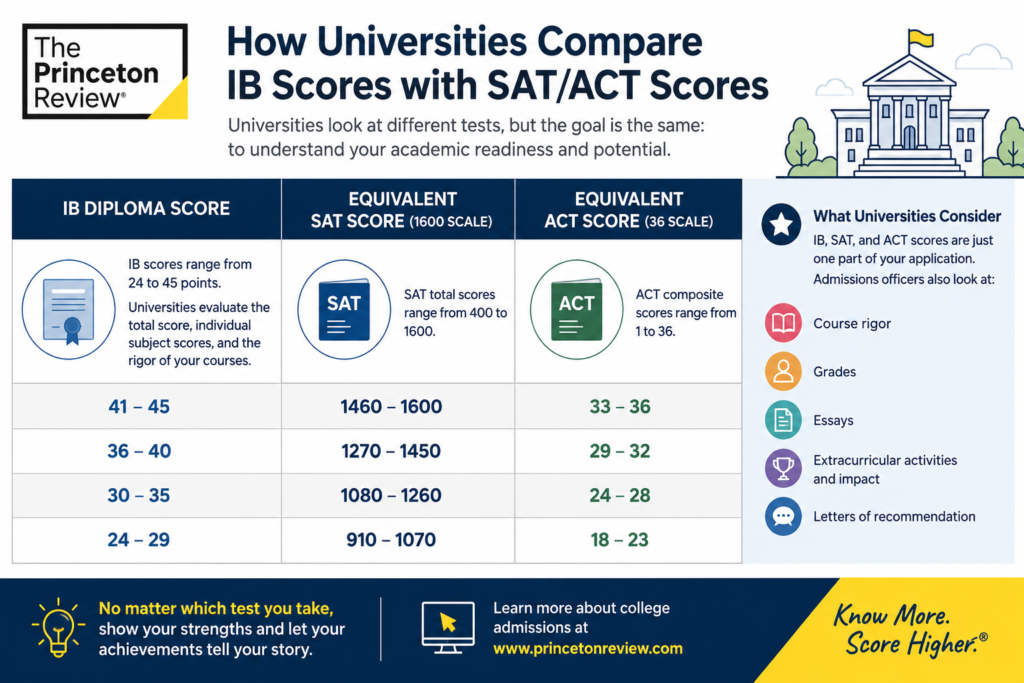
While universities avoid publishing official conversion tables, admissions trends over the years suggest some rough equivalencies.
Here’s how they often informally view them:
- IB 40–45 → Competitive at top-tier universities (often comparable to top SAT/ACT percentiles)
- IB 36–39 → Strong applicant pool at selective universities
- IB 32–35 → Solid academic readiness for many respected institutions
- IB below 30 → Context becomes critical (school rigor, upward trends, personal factors)
These aren’t formulas—just patterns observed by counselors and admissions professionals over time.
Higher Level Subjects Can Matter More Than the Total Score
A detail that nobody will tell you: universities care vastly about what subjects you did, not just the points you got.
For example:
- A candidate with HL Math AA, HL Physics, and HL Chemistry with a score of 35 might be more academically qualified for pursuing an engineering course than one who attained a score of 38 with fewer quantitative subjects.
- Strong HL performance can sometimes outweigh a lower total IB score.
SAT and ACT scores don’t offer this kind of subject-level insight, which is one reason IB is so highly regarded.
International vs. Domestic Applicants: Different Lenses
Admissions offices often evaluate IB scores slightly differently depending on your background:
International IB Students
- IB is usually the primary academic benchmark
- SAT/ACT may be optional or unnecessary
- Schools familiar with IB rely heavily on predicted grades
US-Based IB Students
- IB is assessed alongside GPA and course rigor
- SAT/ACT may still be encouraged, depending on the university
- Strong IB performance can compensate for average test scores
In both cases, consistency and academic challenge matter more than chasing a perfect number.
Practical Advice for IB Students Applying to Universities
If you’re navigating this process, here’s what actually helps:
- Focus on strong predicted grades, especially in Higher Level subjects
- Don’t panic about conversions—universities don’t expect you to
- Submit SAT/ACT scores only if they strengthen your profile.
- Explain your curriculum clearly if your school offers a limited context.
- Highlight academic depth, not just the final number.
Most importantly, remember that admissions decisions are holistic. Your scores open the door—but they don’t walk through it alone.
The Real Takeaway
Universities don’t compare IB scores and SAT/ACT scores the way students often imagine. There isn’t a magic calculator, a perfect exchange rate, or a right answer.
Instead, they examine what your academic record reveals about you and your learning style, your thinking style, and your ability to handle pressure over time. In this way, the International Baccalaureate diploma is a language that is clearly understood by universities, and much more thoroughly than a single standardized test score ever could be, that is, if it is understood at all.
If you’re an IB student, your job isn’t to translate yourself into SAT numbers. It’s to present your academic story clearly, confidently, and honestly. The right universities will know exactly how to read it.