
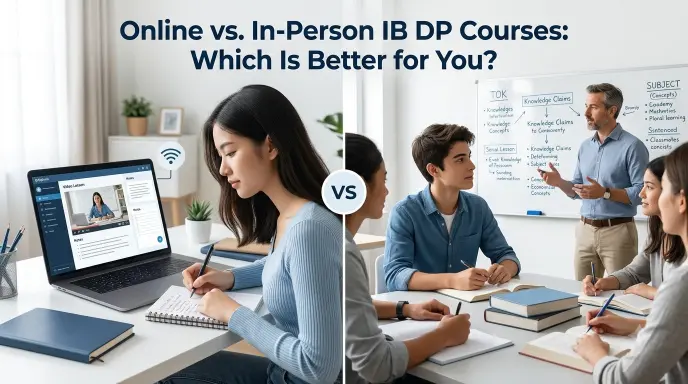
Let me be upfront about something — there’s no clean answer here. Anyone who tells you “online is better” or “in-person always wins” hasn’t sat across from enough IB students to understand how differently people actually learn. This decision is personal, and the right call for your classmate might genuinely be wrong for you.
So rather than ranking formats, let’s dig into what each one actually looks like in practice.
The IB DP Has a Way of Exposing Weak Setups
Two months into the IB programme, most students realise they underestimated it. The subject load is one thing. But layering in the Extended Essay, Theory of Knowledge, and CAS hours on top of six demanding courses — while managing regular assessments — creates a pressure that catches people off guard.
Your learning environment either helps absorb that pressure or quietly adds to it. That’s why this choice matters more than it might seem during registration.
In-Person Learning: What It Does That Nothing Else Quite Matches
The Moment a Teacher Notices You’re Lost
There’s something that happens in a good classroom that no platform has fully figured out yet. You’re sitting in HL Chemistry, pretending you understood the last fifteen minutes, and your teacher just — notices. Maybe it’s your face, maybe it’s that you’ve stopped writing. They pause, try a different angle, draw something out, and ask you directly.
That loop — confusion spotted and addressed before it compounds — happens constantly in strong in-person classrooms. It sounds small until you’re in a subject where every new concept assumes you understood the last one. Math AA works this way. Physics HL works this way. One gap doesn’t stay a gap; it quietly expands.
Accountability Without the Effort of Building It
Self-discipline is genuinely hard at sixteen. Most adults struggle with it, too, honestly. In-person schooling solves a real problem here — it creates external pressure that keeps students moving even when motivation disappears.
Knowing your teacher will ask about your IA draft, knowing your study group meets on Thursday whether you feel like it or not, knowing your absence gets noticed — none of that sounds inspiring, but it works. Students who’ve tried to motivate themselves through pure willpower and failed will understand exactly what I mean.
Knowledge That Travels Person to Person, Not Teacher to Student
Some of the most useful IB preparation doesn’t come from lessons at all. It comes from a Year 2 student telling you which parts of the History syllabus examiners love to test, from a classmate explaining exactly why their TOK essay lost marks, from someone in your study group catching a mistake in your lab write-up at 9 pm because they made the same one.
Physical schools generate these exchanges naturally. You can’t schedule them — they just happen when people share the same space consistently over two years. That informal layer of shared experience is genuinely hard to find elsewhere.
Students who tend to thrive here: Those who need structured environments, lose focus working from home, or do their best thinking out loud with other people around.
Online IB Courses: Where They’ve Quietly Gotten Very Good
The reputation online learning had five years ago — as a fallback option, second-best choice — doesn’t reflect what strong programmes actually look like now. For certain students, learning online isn’t a compromise. It’s the right call.
Geography Hasn’t Stopped Being a Real Problem
Not every student has a well-resourced IB school nearby. Some live in smaller cities where the local school technically offers the Diploma, but staff are subject to teachers who haven’t engaged seriously with the current curriculum in years. That’s not a minor issue — the difference between a knowledgeable IB teacher and an underprepared one shows up directly in student results.
Online programmes let students reach educators who are actively embedded in the IB world — people who’ve marked papers, who know how assessment criteria get applied at the examiner table, who understand the difference between a response that technically answers the question and one that actually earns high marks. That access used to require either the right postcode or a significant tutoring budget. It doesn’t anymore.
Rewatching Explanations Is More Useful Than It Sounds
Some concepts just don’t land the first time. Gaussian elimination, thermodynamic cycles, picking apart an unseen poem under time pressure — these aren’t topics where one good explanation does the job for most people. Needing to hear something twice, or three times, isn’t a sign that something’s wrong with you. It’s just how difficult the material actually is to absorb.
In a live classroom, once the teacher moves on, that explanation exists only in whatever notes you managed to write. Online learning changes that. Rewatching a recorded lesson at your own pace, pausing when something needs more thought, going back after sleeping on it — students who’ve experienced both formats often say this is what they miss most when they return to traditional schooling.
Princeton Review Fills a Gap That Most Schools Leave Open
One honest limitation of even good IB schools is that curriculum delivery and exam preparation are treated as the same thing. They aren’t. Knowing the content is one part of doing well. Understanding how responses are assessed — what language resonates with examiners, which structural choices cost marks even when content is accurate — is a separate skill entirely.
The Princeton Review has built a serious reputation around this very distinction. Their IB preparation support is specific and strategic, focused on how the exam actually works rather than just what the syllabus contains. Students who pair solid coursework with Princeton Review’s structured prep tend to understand their assessments inside and out — and that understanding shows in their results. Online learners particularly benefit here because the flexibility of their schedule makes integrating dedicated prep work more realistic.
The Binary Choice Is a Trap
Plenty of strong IB students don’t operate in a single format. They go to school in person but work with an online specialist for a subject where their school’s teaching is weak. Or they’re enrolled in an online programme but deliberately join a local peer group to stay accountable during the final stretch.
This isn’t hedging — it’s practical. The goal is a setup that actually fits your life, not format loyalty.
Before committing to either format, be genuinely honest with yourself about a few things. Ask whether you actually follow through when nobody is checking — not whether you intend to, but whether you historically do. Think about whether your nearest IB school is genuinely strong or just conveniently located. Consider if there are subjects where you already sense the teaching won’t be enough. And think honestly about whether your life outside school — sport, family, other commitments — makes a rigid timetable realistic or quietly unsustainable.
These aren’t trick questions. They just tend to cut through the noise faster than any format comparison does.
A Note on Online Programme Quality
This matters enough to say clearly. Online IBDP programmes span an enormous range. Some are taught by educators with real examination backgrounds who know assessment criteria from the inside. Others are closer to digital textbooks with a teacher avatar attached.
When evaluating a programme, the syllabus coverage question is almost irrelevant — every programme covers the syllabus. The real question is whether the teaching helps students understand how their work gets evaluated. That’s where the meaningful differences live.
Where This Leaves You
In-person learning offers something that’s genuinely hard to engineer elsewhere — the unplanned moments, the visible accountability, the informal knowledge that moves between students over two years together.
Online learning offers something equally real — specialist access regardless of geography, flexibility that fits complicated lives, and revision tools that let you learn at your own pace — which, when exam season hits, matters more than most people expect.
At the end of the day, no format hands you results. What actually moves the needle is knowing yourself well enough to build a routine that holds up when things get hard — not the version of yourself you hope to be, but the one that actually shows up on a Wednesday night with three deadlines approaching.
Start there. The format question gets much simpler once you do.