
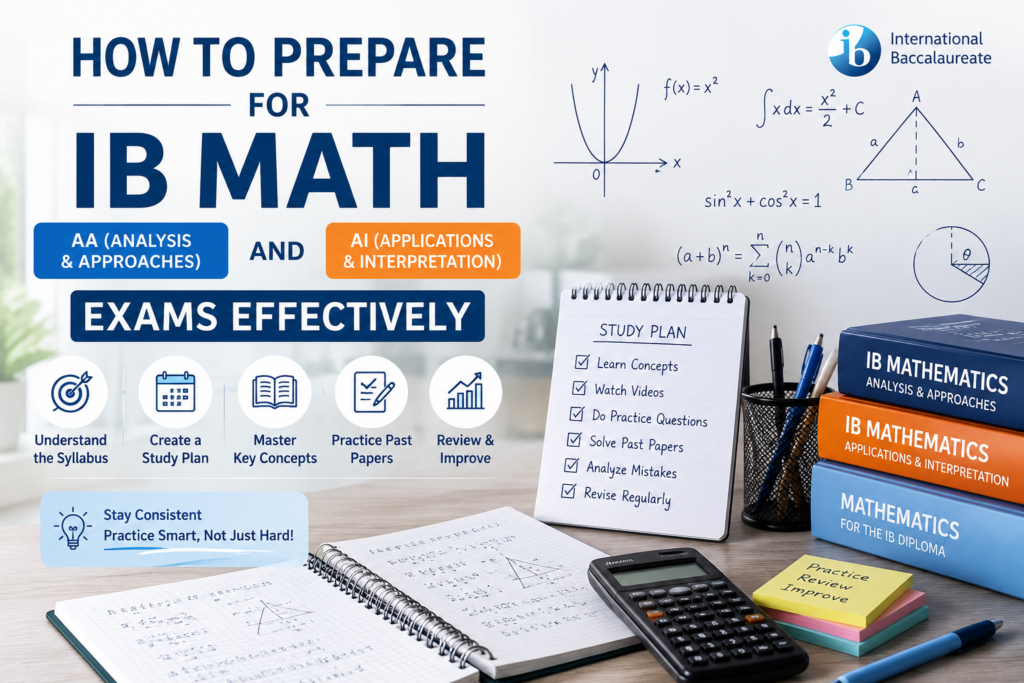
Somewhere around October of Year 2, most IB Math students have a quiet panic moment. The syllabus is enormous, mocks are coming, and the study plan they made in September has completely fallen apart. If that’s where you are right now — or you want to avoid getting there — this is worth reading.
I’m not going to give you a generic “make a timetable and drink water” breakdown. You’ve seen that. Let’s talk about what actually separates students who do well on these exams from those who studied just as hard and didn’t.
One more thing before we get into it — IB Math is not a subject where talent matters as much as people think. Most students who struggle aren’t struggling because they’re bad at math. They’re struggling because nobody showed them how to study for this specific exam. That’s fixable.
The AA vs AI Thing Matters More Than People Admit
A lot of students treat these two courses as basically the same subject with different vibes. They’re not.
Math AA will push you toward abstraction. Proof by induction, complex numbers, calculus, that asks why and not just how. Paper 1 has no calculator, and the questions are deliberately constructed to make procedural thinking fail. If you’ve been coasting on following worked examples without understanding the logic behind them, Paper 1 will find you out.
Math AI lives in context. Every question comes from something real — like numbers collected in a study, how a company runs, or an experiment done in a lab. The math itself isn’t simpler, but it shows up differently. Students who skim past the scenario and rush to the numbers consistently misidentify what the question is even asking. Slow down on the read. That’s not just a small piece of advice.
Understanding which course you’re actually taking — not just the class name, but what it really involves — changes how you should study for it.
Don’t Underestimate the Internal Assessment
Twenty percent of your final grade sits in the IA, and somehow it’s the thing most students half-ignore until it’s nearly due. Pick something you’re actually interested in — not the topic that sounds impressive at a dinner table, but the one you’d genuinely keep reading about at midnight. A straightforward idea explored properly will outscore a complicated one handled messily every single time. Go to your teacher for feedback more than once. And whatever you do, don’t save the actual writing for the final week. That never ends well. Twenty percent is too much to throw away.
Stop Avoiding the Topics You’re Bad At
This one is uncomfortable, but it’s the whole game.
When students sit down to revise, they naturally drift toward what they already understand. It’s comfortable. It feels like progress. It isn’t.
Go through your syllabus point by point. Be honest. Not “do I recognize this” honest — “could I answer a question on this cold, right now” honest. Those are very different things.
Whatever comes up as genuinely shaky — binomial theorem, vector equations, chi-squared testing (if you’re AI), Maclaurin series (if you’re AA), whatever yours are — that’s where your time goes. Not evenly distributed. Disproportionately there. Students who fix their bottom three topics gain more marks than students who polish their top three.
Make a Simple Weekly Plan — But Keep It Realistic
Forget the elaborate planner. Seriously. Sunday night, write down three topics you’re hitting that week. That’s the whole system. The students who actually improve over time aren’t doing something clever — they’re just not stopping. Bit by bit, week by week. The ones who burn out are usually the ones who tried to do everything in the first three weeks and had nothing left by April.
Past Papers: You’re Probably Using Them Wrong
Done a bunch of past papers and still not seeing improvement? The issue usually isn’t effort — it’s method.
Doing full papers back to back when your content knowledge still has holes is like practicing free throws with bad form. You’re just reinforcing the problem. Instead, break papers apart. Take every differential equations question from the last seven years and do them in one sitting. Same for probability. Same for whichever topic keeps tripping you up. You’ll see in about twenty minutes how the same underlying idea gets dressed up in different ways — and suddenly the questions stop feeling unpredictable.
Full-time papers under proper conditions belong in the six weeks before the exam. That’s when past papers become about exam rhythm and pressure management, not content.
Every wrong answer gets written in a notebook — not just the correction, but what you were thinking. That notebook is the most useful thing you’ll have in the final two weeks.
Work With a Study Partner on Hard Topics
This sounds basic, but it genuinely works. Grab someone from your class who struggles where you don’t. Sit down, swap knowledge, and actually talk through the material out loud. You’ll notice pretty fast that explaining something to another person is completely different from understanding it in your own head. Halfway through a sentence, the explanation just stops making sense — and that moment, as uncomfortable as it is, tells you exactly what you still need to work on.
How Princeton Review Works for IB Math Specifically
Most prep resources teach math. Princeton Review provides IB maths prep — there’s a real difference.
Our materials are built around how the IB actually awards marks, which turns out to be its own skill. The way a question is phrased, where the method marks sit, what the markscheme accepts and doesn’t — Princeton Review bakes that awareness into the practice problems rather than leaving you to figure it out from scratch. Students who study regular textbooks first and then use a Princeton Review guide often say it’s the first time the exam questions start to make sense as a whole, instead of just being a bunch of tricky problems.
It works particularly well if self-studying feels chaotic. The structure is clear, the difficulty progression is deliberate, and the explanations don’t just show you the answer — they show you how an experienced IB teacher thinks through the question. For Math AI, the statistical sections are especially good. For Math AA, the calculus and proof coverage is thorough without being overwhelming.
If you’re going to invest in one external resource, this is the one worth it.
Your GDC Is Doing Less Work Than It Should
AI students — if you’re not running hypothesis tests directly on your calculator, finding regression lines, and reading statistical outputs without hesitation, you’re losing marks that require almost no mathematical thinking to get. It’s purely a familiarity issue.
AA students — Papers 2 and 3 are where the calculator earns its keep. Verifying analytical answers graphically, sketching function behavior, catching sign errors before you commit them to the page. Students who are genuinely fluent with the GDC catch mistakes that everyone else makes.
Spend a dedicated hour just on the calculator technique. Not inside a past paper — separately, deliberately. Almost nobody does this. Almost everybody should.
Don’t Ignore the Formula Booklet
Every IB Math student gets a formula booklet in the exam. Most students only look at it when they’re stuck. The better approach is to study with it open from the beginning of Year 2. Know where everything is. Know what’s in there so you’re not wasting exam time flipping through pages. And just as importantly, know what’s not in there, because those are the things you actually need to memorize.
Check :- IB Math Data Booklet
Three Things That Lose Marks in the Room
Time. If a question is eating your paper alive, leave it and come back. An untouched question at the end is a guaranteed zero. A partial answer to a hard question might still get you two or three marks.
Working. Write it all down, especially on Paper 1. Examiners look for method marks. A wrong answer with clear, correct reasoning still scores.
The question itself. Read it twice. Especially in AI, where the actual task is buried in a paragraph about penguin populations or factory output. The students who dropped marks here aren’t weak at math — they just answered a slightly different question than the one that was asked.
To Close
Good preparation for IB Math isn’t about volume. It’s about targeting the right things, using resources that understand the exam — Princeton Review being a solid starting point — and building the kind of familiarity with question structures that makes nothing feel like a complete surprise on exam day.
Start earlier than feels necessary. Fix the problems first before spending time improving what’s already okay. And don’t underestimate how much a well-organized six weeks can change the outcome.