
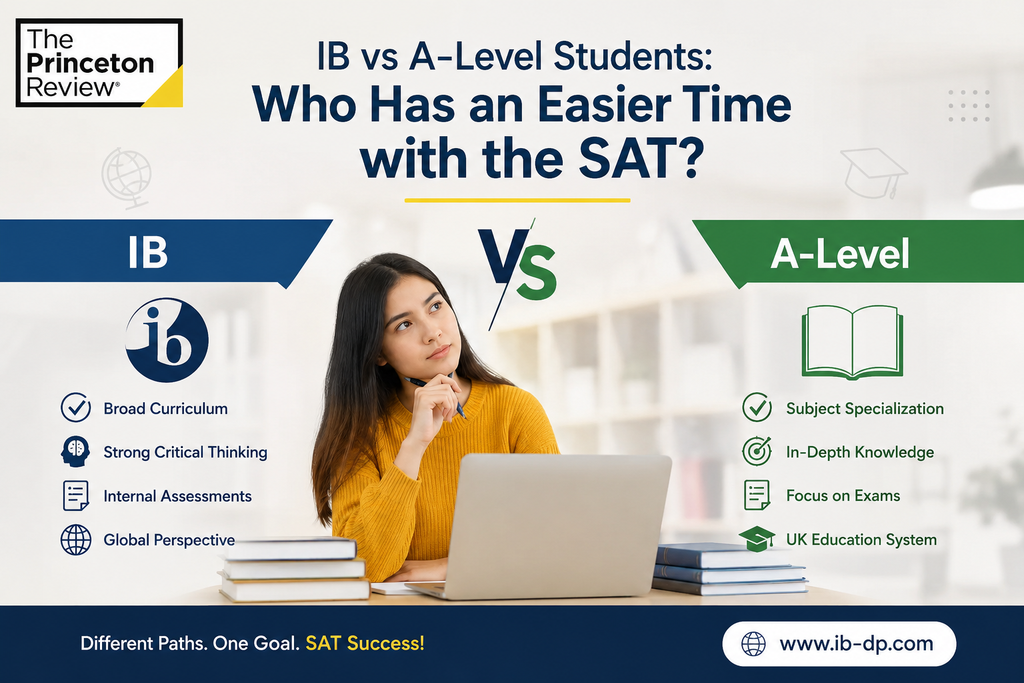
Every January, the same argument breaks out in junior college canteens and IB common rooms across Singapore. Someone mentions the SAT, and within a minute, the room splits into two camps. “IB kids have it easy; they’ve been writing essays for two years.” “Please — JC students will wipe the floor with that math section.”
We’ve watched this exact debate play out for years at The Princeton Review Singapore, often while two students from opposite tracks sit in our waiting room comparing diagnostic scores, half-joking about who’s going to do better. And here’s the thing nobody in that canteen argument quite gets right: it isn’t really a contest. What we see, term after term, is two groups of students who’ve spent two years being trained in completely different directions, and neither direction happens to line up perfectly with what the SAT is actually testing. Both arrive with real advantages. Both also arrive with real blind spots, and pretending otherwise doesn’t help anyone walk into test day better prepared.
Two Curriculam, Two Very Different Mental Habits – IB vs A-Level
IB and A-Level students aren’t just covering different content in school. Without either program explicitly designing it that way, each one nudges students toward a particular style of thinking long before anyone mentions the word SAT.
Spend two years writing Extended Essays, sitting through Theory of Knowledge seminars, and producing internal assessments, and you build a specific skill: sitting with a dense, unfamiliar text, forming an actual position on it, and defending that position using the text itself rather than instinct. That happens to be almost exactly what the SAT’s Reading and Writing module checks for. The correct answer is rarely the one that “feels” right. It’s the one that the passage can genuinely support, sentence by sentence. We tell our IB students this constantly during the first few sessions, mostly because it takes the pressure off — they already half-know how to do this.
A-Level students, on the other hand, often go far narrower but much deeper, and Math is usually where that depth shows up most clearly. Two years of grinding through H2 Math — vectors, calculus, probability, the lot — and a system of equations on the SAT barely register as effort. It isn’t some innate gift. It’s repetition, plain and simple, the kind that comes from solving the same family of problems hundreds of times over until the steps stop requiring conscious thought.
Where IB Students Tend to Pull Ahead
Reading and Writing on the SAT isn’t measuring how many novels someone’s read for fun. It’s measuring whether a student can move through an unfamiliar passage quickly, under a ticking clock, and still make sharp, precise calls about grammar, structure, and meaning. IB’s relentless demand for close reading — not just in English Lit but across History essays, Science write-ups, even Math internal assessments — gives students consistent, almost unavoidable practice at exactly that.
There’s a quieter advantage too, one we notice far more in tutoring sessions than in any score report. IB students generally don’t flinch when a passage runs long and wordy. Two years of TOK essays will do that to a person. A dense SAT passage doesn’t feel intimidating to them. It feels routine, almost familiar, like something they’ve already survived a few dozen times.
Where A-Level Students Tend to Pull Ahead
Flip over to the Math module, though, and the advantage swings hard the other way. A JC student deep in H2 Math is often operating well past what the SAT actually requires. Questions on algebra, functions, or data analysis — the type that might genuinely slow down a less math-focused IB student — can feel almost too easy to someone mid-syllabus in A-Levels. We’ve had students laugh out loud during a diagnostic because a question they expected to be tricky turned out to be something they’d solved in Secondary 4.
Take IB Math Classes – Join Now
There’s a psychological bonus tucked in there as well. Early confidence in a test changes how a student paces everything that comes after. A JC student who flies through Math often arrives at Reading and Writing calmer, with more mental energy left for the harder, slower passages near the end of the module.
So, Who Actually Has It Easier?
Neither group, if we’re honest — and we say that having coached plenty of students from both sides toward strong results. What we consistently notice instead is this: IB students often need extra, deliberate work on the Math module, particularly around pacing and getting comfortable with how SAT questions are phrased, since that phrasing doesn’t always match the framing used in IB Math AA or AI. A-Level students, meanwhile, frequently need focused practice on Reading and Writing — not because their reading ability is weak, but because the SAT rewards a very specific kind of evidence-based reasoning that an A-Level syllabus rarely spends time building.
Here’s roughly how it tends to play out in our diagnostics:
- IB students typically start strong in Reading & Writing but gain the most from additional timed Math drills and exposure to SAT-specific question phrasing.
- A-Level students typically start strong in Math but gain the most from structured reading strategy work and faster evidence-spotting practice.
- Both groups, without exception, benefit from sitting full-length, timed practice tests early — because neither curriculum quite recreates the specific pressure-cooker feel of the digital SAT.
So if the real question is “who has it easier, IB or A-Level,” there isn’t a clean winner waiting at the end of that sentence. Both groups show up already halfway prepared, just from opposite directions, and both still need several focused months to close whatever gap remains before test day. We’d argue that’s actually good news — it means nobody is starting from zero.
A Quick Story From Our Classroom
Last year, one of our JC1 students walked in with a near-perfect H2 Math track record but kept scoring noticeably below target on Reading and Writing — a gap that didn’t quite add up given how sharp he clearly was in every other subject. It turned out comprehension was never the issue. He was reading SAT passages the same way he’d read a Physics problem set: scanning for “the answer” instead of following what the author was actually building toward. Once he shifted his approach and started treating each passage like a compact essay with its own thesis, his score climbed noticeably within a matter of weeks, and that habit carried straight into his second attempt months later.
We’ve seen the mirror version with IB students too — sharp, articulate writers who simply hadn’t logged enough timed math repetitions to move through the section quickly without second-guessing every other step. One student we worked with kept re-checking simple algebra questions three and four times out of pure habit, burning minutes she desperately needed elsewhere on the test. Neither fix required reinventing anything. Both just needed coaching pointed at the actual gap, rather than a generic review that treated every student the same regardless of their starting point.
How The Princeton Review Helps, Whichever Track You’re On
This is precisely why we don’t hand every student the same generic SAT plan and call it a day. At The Princeton Review Singapore, our instructors build each study plan around where a student is genuinely starting from, not around a one-size-fits-all syllabus that assumes everyone needs identical hours on identical topics. IB students working with us usually spend more guided time on Math fluency and timing drills; A-Level students usually spend more time on evidence-based reading strategy and the grammar conventions unique to the digital SAT.
Our courses are led by US-certified instructors and built around full-length practice tests delivered on the same Bluebook™ platform used on actual test day, so students from both tracks experience the real format and the real time pressure well before it counts toward anything that matters. Whether you’re an IB student tightening up your Math pacing or a JC student sharpening your reading strategy, our diagnostic testing pinpoints exactly what your curriculum has already given you for free — and exactly where a few focused weeks of coaching can make the difference between a decent score and the one you actually need for your target schools.
The Real Takeaway
The IB vs A-Level argument is fun to have in the canteen, but it shouldn’t really shape how you prep. What matters more is figuring out where you’re actually starting from — which skills your two years of school already handed you, and which ones still need real work before test day. IB students usually walk in reading well. JC students usually walk in, calculating fast. Neither one is enough on its own. Put either advantage next to a prep plan built around your actual gaps, though, and you’ve got more than enough to land the score you’re after. Save the debate for the canteen — spend your actual energy here.