
A student I know spent three weeks preparing for the wrong version of her IB History exam. Not the wrong subject — the wrong format. Her school had quietly opted into the digital pilot, and the communication hadn’t reached her clearly enough. She found out properly about two weeks before May.
She passed. But those two weeks were rougher than they needed to be.
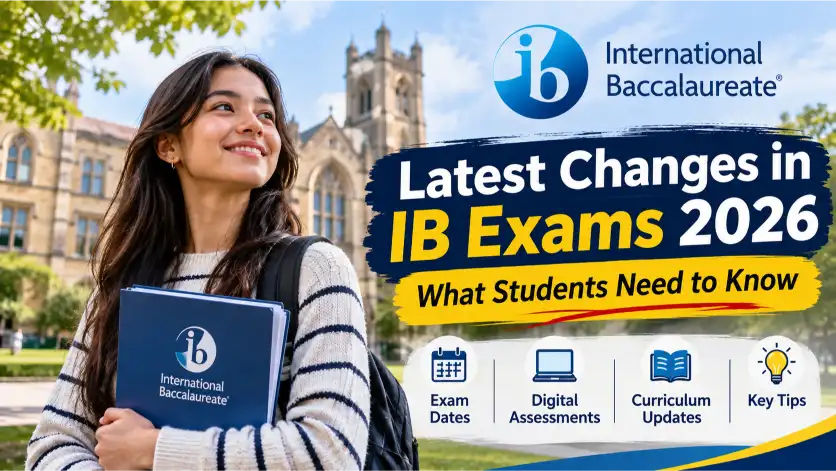
If you’re sitting IB exams in 2026, here’s what’s actually changing — and what that means for the way you prepare. Not the official press release version. The version that’s actually useful.
The Digital Thing — What It Is and Isn’t
The IB has been moving toward digital exams for years. 2026 is when it starts mattering for real students in real schools.
From May 2026, schools can choose to deliver certain subjects digitally rather than on paper. Key word: choose. It’s optional at the school level. Not every school is joining. The subjects starting the rollout are Language and Literature and Language Acquisition — partly because they’re essay-heavy, partly because those are the subjects where the IB wants to understand what digital delivery actually changes about performance.
By November 2026, the option will open to every IB school globally. Which means if your school hasn’t participated by then, it almost certainly will soon.
Here’s what keeps getting misunderstood: the exam content is identical. Same syllabus. Same mark schemes. Same grade boundaries whether you’re typing or handwriting. A student sitting digitally and a student sitting on paper are being assessed against the same criteria.
The medium changes. The exam doesn’t.
That sounds minor until you’re ten weeks out and realise you’ve never practised writing a structured analytical essay against a clock on a keyboard. Then it stops sounding minor. Students who treat the format change as a non-issue and don’t adjust their preparation are the ones who feel it on exam day.
The Anti-Cheating Protocols — Read This Part
This gets less coverage than the digital rollout. It probably shouldn’t.
After exam questions leaked online during May 2024 — students in earlier time zones sharing content with students sitting later in the day — the IB introduced a set of measures that are now standard across all sessions.
Students are supervised for at least two hours after their exam ends. Some schools have had start times adjusted specifically to close the window between time zones. Calculators get their memory wiped after exams. None of this is optional. None of it is school-specific.
It applies to everyone sitting IB exams in 2026, regardless of subject, level, or location.
If you’re planning to walk out of your exam room and immediately call someone to compare answers — that’s not happening. Build the supervision period into your day. Tell whoever’s picking you up. Let your family know not to expect you the moment the exam ends. It sounds like a small logistical thing, and it is, until it isn’t.
Dates Worth Having in Your Head Now
The May 2026 exam session runs from late April through to mid-May. Results day is Monday, the 6th of July — schools receive access the evening before, students from early afternoon on the day itself.
UK university applicants don’t need to do anything extra. UCAS gets results directly, and Track updates on results in the morning.
Worth knowing this far in advance because scholarship deadlines, conditional offer conditions, and accommodation deposits all cluster around results day. Being surprised by the timing in July is completely avoidable if you’ve planned for it now. University accommodation deadlines, in particular, have a habit of arriving faster than expected after results.
If Your School Is Going Digital
Content preparation stays the same. A few other things don’t.
Typing long analytical responses under timed conditions is genuinely different from handwriting them. Not harder necessarily — different. Sentence construction changes. The way you edit changes. The way you track your argument across a long response changes. If you’re sitting in History or Language and Literature digitally and haven’t yet practised producing structured written responses on a keyboard against a clock, start doing that now. Not at some point. Now.
Screen fatigue across a two or three-hour paper catches people off guard. Sitting with a screen for three hours of concentrated reading and writing is its own experience. Build that stamina specifically, rather than assuming general exam stamina transfers automatically.
Know your device before exam day. Know the interface. Know what tools are available to you and what aren’t. Finding out something unexpected about the platform at 9 am on the morning of your exam is genuinely not an experience you want.
Princeton Review
The content of IB exams hasn’t changed. That’s actually the reassuring part — and the part worth focusing your preparation around.
What examiners want in a Level 7 response — the analytical structure, the specificity, the thread of argument running through a strong essay — is identical whether you’re typing or writing by hand. The screen changes nothing about what a high-scoring answer actually looks like on the inside.
Princeton Review’s IB prep is built around the examiner’s perspective specifically. Not just syllabus coverage, but the real distinction between a response that scores well and one that scores adequately. In Higher Level subjects, that distinction almost always comes down to technique rather than knowledge. Knowing the material well isn’t the same as knowing how to deploy it under timed pressure in the structure that an examiner recognises as strong.
For students juggling multiple HL subjects — which is most IB students — that technique gap tends to show up differently in different subjects. Princeton Review’s tutoring addresses it specifically rather than generically. No time spent reviewing things you’ve already absorbed. Just the particular places where marks are being left behind.
If your content feels solid but practice scores aren’t reflecting that, the issue is almost certainly technique. One subject at a time, one gap at a time. That’s where their one-on-one sessions do the most useful work.
Paper or screen in May 2026, the core preparation is the same. Think clearly, write precisely, and know what the examiner is actually looking for. Those three things haven’t changed and won’t.
What To Do With All This
First — find out whether your school is participating in the digital pilot. If nobody has told you clearly, ask this week. Not in March.
Going digital? Start practising in the actual format. Timed, on-screen, typing full essay responses. Not just reading about what the format involves — doing it.
Staying on paper? Content prep is unchanged. Know about the supervision period after your exam ends, sort your calculator beforehand, and factor the new timing protocols into your post-exam day.
The IB is changing — carefully, gradually, in a direction it’s been heading for years. 2026 is one step in something longer. The things that make a strong IB student haven’t shifted: careful thinking, precise writing, and genuine engagement with the ideas in each subject.
Those are still what the exam measures. Prepare for those first. Everything else follows.