
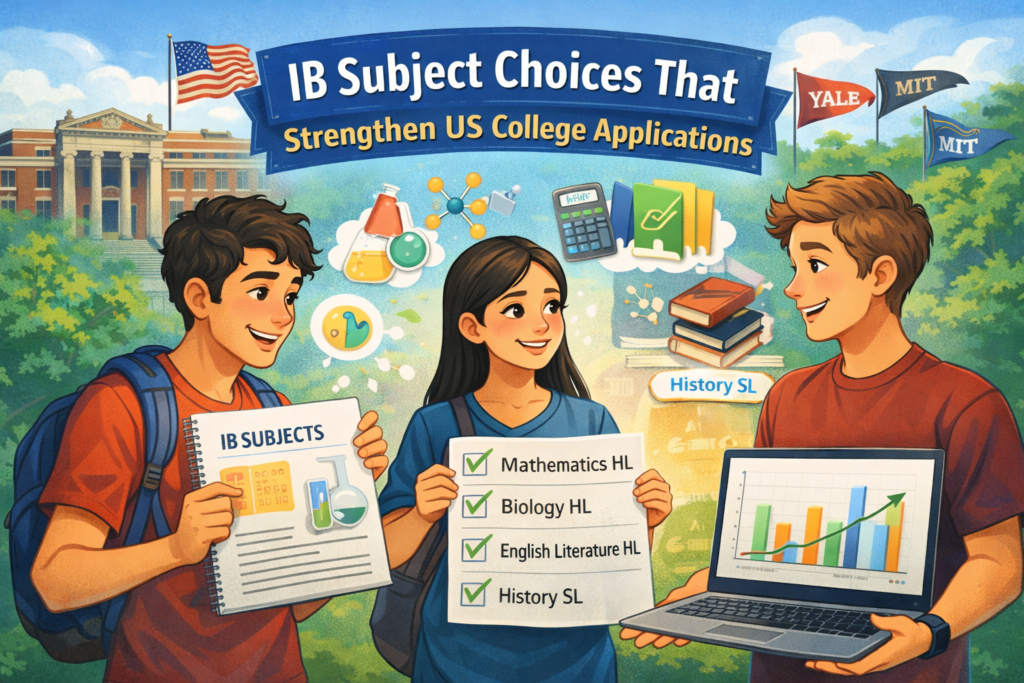
When students begin the IB Diploma, one question shows up almost immediately: “Which subjects will look best for US colleges?” And yes, this is something important. Your subject choices don’t just fill out a timetable — they quietly communicate how you think, what you care about, and how ready you are for academic life at a university level.
US colleges don’t expect perfection or a single “correct” combination. What they value is intention. Your choice of subjects also reveals something to the reader: a story of personal interests, academic maturity, and desire to take risks.
Let’s discuss how to ensure those decisions are on your side.
How US Colleges Actually Look at IB Subjects
One of the biggest misconceptions is that admissions officers count how many HLs you have taken. In reality, they look deeper. They want to understand why you chose certain subjects and whether those choices support your future goals.
Admissions readers often ask:
- Does this student take academic risks?
- Do the HL subjects align with the intended major?
- Is there a healthy balance between rigor and breadth?
A student applying for engineering with advanced math and physics looks academically prepared. A student applying for international relations with history, economics, and strong writing-based subjects sends a different — but equally compelling — message.
Higher Level Subjects That Carry the Most Weight
Mathematics: Opening (or Closing) Doors
If your focus is STEM, economics, or a highly competitive business program, Math AA HL is one of your strongest applications. In fact, in the United States, this is considered a clear indication of your ability to manage challenging quantitative classes.
Math AI HL can still work for certain majors, but students should understand that it may limit options at more selective institutions. When in doubt, choosing the more rigorous path — if you can manage it well — often pays off.
Science Choices That Show Serious Commitment
HL sciences matter most when they match your academic direction:
- Physics HL supports engineering and computer science applications
- Chemistry HL is important for pre-med and chemical sciences
- Biology HL fits well with health, life sciences, and psychology-related fields
What matters isn’t collecting science HLs, but demonstrating focus. Two well-chosen sciences with strong performance usually speak louder than overloading your schedule.
Humanities Subjects That US Colleges Respect
History, Economics, and Global Perspectives
Studying humanities HLs can be ‘incredibly powerful,’ particularly for those with an interest in areas such as law, policy, or even economics.
- History HL demonstrates depth, discipline, and the ability to handle a substantial workload of reading.
- Economics HL demonstrates analytical thinking and familiarity with real-world data.
- Global Politics HL is a good choice for students interested in foreign affairs/diplomacy.
These subjects also help students stand out in essays, because they naturally train you to form opinions and defend them clearly.
English: Often undervalued, but quietly important
Strong writing matters in US colleges — across all majors. Selecting English A HL can positively contribute to applications, especially when students aim at liberal arts college applications or highly competitive universities where discussion-based learning and research-based writing can be important strengths.
Having strong preparation in English can also signal balance for even STEM students.
Arts Subjects: A Strategic Advantage When Used Well
Arts subjects are sometimes dismissed as “soft,” but US colleges don’t see them that way — especially when they fit your narrative.
For a student into architecture, design, film, or media studies, the Visual Arts, Film, or Theatre is very relevant. These subjects reflect originality, discipline, and creative thinking.
The key is pairing creativity with academic rigor. That combination often makes an application memorable.
Why Balance Matters More Than Perfection
US universities don’t want specialists who can only operate in one academic lane. They look for students who can think broadly.
A strong IB subject mix usually includes:
- At least one demanding analytical subject
- A course that develops writing and communication
- One subject that reflects personal interest or creativity
This balance shows curiosity and adaptability — qualities US colleges value highly.
Don’t Ignore Your SL Subjects
While HLs attract attention, SL subjects complete the picture. Weak or random SL choices can raise questions.
For example:
- A future business student should still show competence in the humanities.
- A science-focused student benefits from psychology or economics to show broader thinking.
Consistency across the diploma often matters more than a single standout subject.
Matching Subjects With Intended Majors
Your subject choices don’t need to lock you into a career — but they should make sense.
Common pairings that work well:
- Engineering → Math AA HL + Physics HL
- Economics → Math AA HL + Economics HL
- Pre-med → Biology HL + Chemistry HL
- Law or humanities → History HL + English HL
If you have not decided on your subjects yet, choose those that keep multiple paths open rather than narrowing options too early.
Where Princeton Review Adds Real Value
Many IB Exam students struggle to connect subject choices with the broader US admissions process. This is where guidance from experienced organizations can help.
The Princeton Review often works with IB students to:
- Align IB subjects with SAT/ACT preparation
- Position academic rigor clearly for US admissions officers
- Build cohesive applications where grades, subjects, and essays support one another
That kind of strategic alignment can make strong subject choices even more impactful.
Common Mistakes Students Regret Later
Some missteps show up again and again:
- Choosing subjects based only on what feels “safe”.
- Ignoring how subjects support future goals
- Taking on too many HLs without considering the workload
- Copying someone else’s subject combination
US colleges value authenticity. Your choices should reflect you, not someone else’s plan.
Final Thought
IB subject choices are not about impressing admissions officers with difficulty alone. They’re about showing direction, curiosity, and readiness for the next academic step.
If your subjects make sense together and reflect genuine interests, that clarity will come through. With thoughtful planning — and, when helpful, guidance from experienced advisors like those at Princeton Review — your IBDP choices can quietly become one of the strongest parts of your US college application.
Choose with intention. That’s what lasts.