
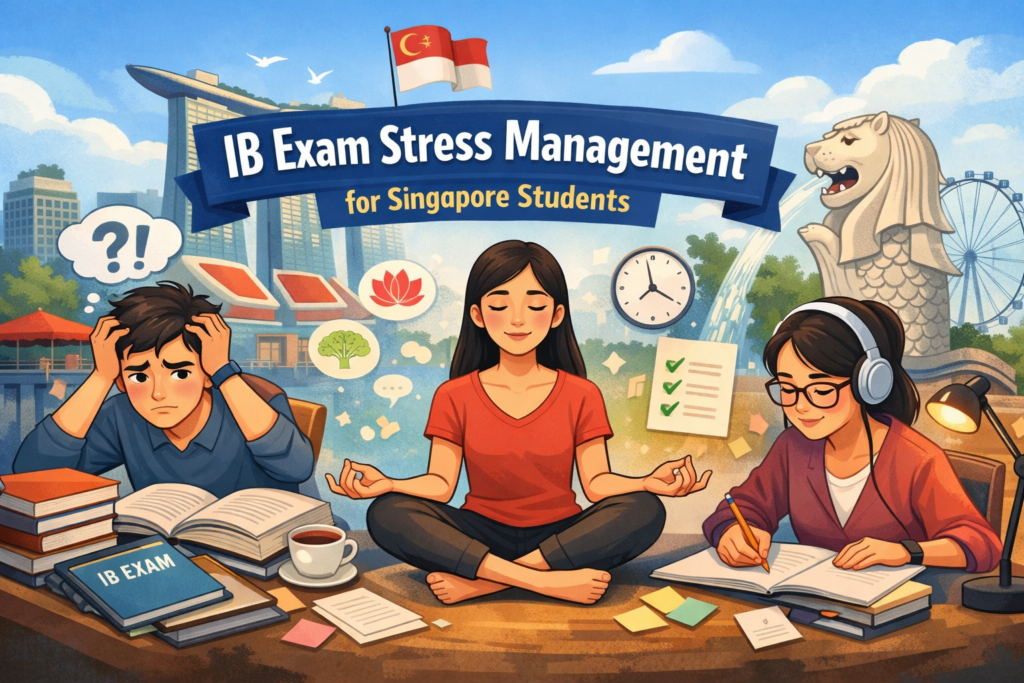
“The International Baccalaureate Diploma Programme is renowned for being quite challenging.” Every student in Singapore faces their own set of challenges while pursuing this rigorous rigorous program. There are many components- Internal Assessment, Extended Essay, CAS, and examinations, that a student can get flustered with. But there’s some good news – this blog will help you eliminate in IB exam stress and help you achieve success!
Strategies to Beat IB Exam stress in Singapore
Why IB Students Feel Pressure
The cut-throat competition in Singapore injects an extra dose of tension into an already rigorous IB program. Students here might be taking a multitude of Higher Level classes, school extracurriculars, and university application requirements, all in an effort to score the so-necessary 45 points. Such a recipe for disaster can quickly spiral into exhaustion if not balanced.
The pressure is not just intellectual. They are dealing with pressure while striving to make their parents proud of them, striving for admission into elite universities, and observing how everyone else seems to easily navigate through these processes. Of course, social media exists, making life even harder for them. Seeing others highly talk about their accomplishments on Facebook, Twitter, or whatever, it is easy to think that they are all putting it together. Newsflash: they’re not.
Understanding Your Stress Triggers
Before learning how to manage stress, you need to understand its cause. For some students, it is the fear of disappointing others. For others, it is the volume of syllabus to cover or uncertainty about what questions might appear on exams. Some common IB-specific stressors include:
- The unpredictability of Paper 1 and Paper 2 content
- Time management during Theory of Knowledge essays
- Balancing CAS hours with academic demands
- Meeting Internal Assessment deadlines across multiple subjects
- The weight of the final exams determines two years of work
Knowing the cause of your stress allows you to develop targeted coping strategies rather than feeling generally anxious about everything.
Smart Study Strategies That Work
Set Clear Goals and Create a Study Plan: Goal setting is the starting point that needs to be taken into consideration. It acts as a motivating factor to keep you encouraged throughout your journey. Break your learning subject into smaller pieces. Make a more intensive study plan. It will help you organize your study process. Make specific goals for your study sessions. After achieving them, it also creates a sense of achievement.
Develop a Productive Study Routine: A good routine of studies can very much enhance your motivation and efficiency. Study when you feel most awake and plan your day around that time. Also, include short breaks in between to prevent distraction and to maintain focus easily. At that moment, following the technique of studying for 25 minutes and taking a break of 5 minutes afterwards will be efficient.
Include Active Learning Techniques: You must develop techniques that will help you in making your learning procedure colorful and interesting. Along with this, you can also take assistance from online IB tutors like the Princeton Review in case you find any trouble while learning any subject; these tutors will help you out in resolving your queries as well.
Tip: IB past exams and online resources will help assess knowledge retention and develop effective learning strategies.
Form Study Groups Strategically: Doing some group study work may keep IB students motivated and provide a faster way to understand tricky concepts. When setting up group study work, make sure you pick group members carefully and pick people with strengths in different areas, like English and math. Finally, groups need to be well-planned to make the process helpful to you and not create more stress in your life.
Set Up Your Studying Area Correctly: The area where you choose to study is much more important than you realize. Get a quiet area where you can actually think. The phone needs to go into another room, or turned off altogether—those texts will wait. If studying from the computer, shut down any tabs that are not being used. It is helpful if the desk is clean, as well. Understand how easily you can concentrate with nothing but open surrounding spaces and no reminders of messages waiting for your check.
Mental Wellness: Your Secret Weapon
Your brain is not a machine that can run indefinitely. Good mental health is important for doing well academically.
Prioritize Sleep: Late-night studying and poor sleeping can result in very serious issues. For teens, it requires at least 7-8 hours for the effective functioning of the nervous system. Of course, it would be great if all the answers were remembered in the examinations, but the plan may turn out to be a massive failure if sleeping doesn’t go well. The best sleeping time for students requires them to go to bed at 10-10:30. Remember, “Early to bed, Early to Rise.”
Practice Exercise Regularly: Exercise helps to reduce stress and also to concentrate well. You do not have to go crazy on exercise because if you walk around your neighborhood for 20 minutes or do yoga or dance to your favorite songs, it helps your concentration by cleaning your mind. Many students find it helpful to come back to their studies after exercise with a lot of strength.
Practice Mindfulness and Breathing Techniques: This will lead to quick and shallow respiration. Breathing exercises can also be the antidote for panic. You can perform the 4-7-8 breathing exercise. This involves exhaling for 4 seconds, pausing for 7 seconds, and then exhaling for 8 seconds. These applications: Headspace and Calm have meditation for students going through exams. They can also be helpful for those going through stress.
Be Positive and Confident: How confident are you in yourself that you can surely score well in the exams? Your answer will determine your preparation level, but the goal here is to maintain a positive outlook. “You can do it”. Just use these four words whenever negative thoughts circle your head. By replacing negativities in your thoughts with positivity and self-confidence, you can certainly overcome very stressful situations in life.
Eat healthy, Stay Hydrated: Take a healthy diet, because that’s what most people, including students, tend to forget. Compromising with health doesn’t help, and chances are high that you may get ill. Your goal should be to appear for the exams in perfect health, and that is only possible by eating healthy and organic food and drinking plenty of water. Pick an apple or a banana when you are studying, keep a bottle of water beside your study table, and no junk food until your exams are over.
Know When to Ask for Professional Help: In other cases, if you find that stress has built up beyond your control and then affects your sleeping, appetite, or ability to function, it might be best to see a mental health therapist. This is not something to be ashamed of but rather a sign of strong mental character.
Test Day Tactics
All your preparation culminates in exam day. Here’s how to deliver at your highest ability when crunch time rolls around:
Night Before Prep Work: You have to prepare all exam-related materials like pens, pencils, a calculator, and your ID/Water bottle one night earlier. You have to check the venue and the timing of the exam. Prepare your comfortable clothes.
Arriving Early: It is always a very prudent move to make in order to ensure that, in the event of any unexpected delays, you would be prepared to handle such situations. Also, arriving early will provide you with some extra time to get used to the atmosphere.
Read the Instructions Carefully: This may be obvious to readability experts, but nervous energy related to preparing for a test can easily lead a person to not read a question carefully.
Time Management: Allocate your time for each question proportionally to the marks assigned to it.
Trust Your Preparation: You have prepared well. Have a little faith in what you have prepared for yourself. Do not second-guess yourself too much.
The Princeton Review Advantage
And taking on the IB program alone is not necessary. The Princeton Review takes pride in having been able to help many candidates across the globe in pursuing their educational goals. They have effective methods for preparing candidates for a number of exams. They are up to date with the IB Syllabus. They can assist candidates in achieving success in Singapore.
Whether it is help with particular subjects, techniques for taking exams, or a comprehensive education plan in totality, the Princeton Review will provide suitable alternatives that suit your needs. The success story proves itself through the endless list of learners who have made their IB education from frustrating to possible through the right assistance.
Building Long-Term Resilience
The abilities you are going to learn in dealing with the pressure of IB exams are much broader than the IB Diploma itself. Preparing for examinations and staying focused are some of the most important qualities you can have in university and professional life.
Develop a Growth Mindset: Challenges should be seen not as threats but as opportunities for growth. You can develop a growth mindset by thinking that when you do not understand a particular concept, it does not mean that you are not capable, but that the process of learning it involves difficulty.
Celebrate Small Wins: Completed a practice paper? Learned a tough topic? Yes, you can celebrate these victories! Such victories will ensure you stay motivated throughout the IB experience.
Learn From Failures: If a practice test session is not successful, it is important to learn from it by understanding areas where it failed. Was it related to time management issues? Gaps in learning? Or anxiety related to testing?
Your Success Blueprint
How to reduce IB exam anxiety: Rather than trying to eliminate pressures, it can be directed towards productive ends. Start practicing preparations early. Opt for proper learning strategies. Look after your health. Don’t hesitate to seek external aid if you require it. There are thousands of Singaporean students who have made it through successfully every year.
Although there may be obstacles to reaching your objectives, it has instead made you stronger. By means of proper planning, resource asset, combining a well-rounded strategy, and having experts such as the Princeton Review team behind you, you can confidently take on your IB exams as well as successfully reach your objectives.